You React First and Pull Away After. That Is Not Dismissive Avoidant. Here Is What It Actually Is.
Jul 16, 2026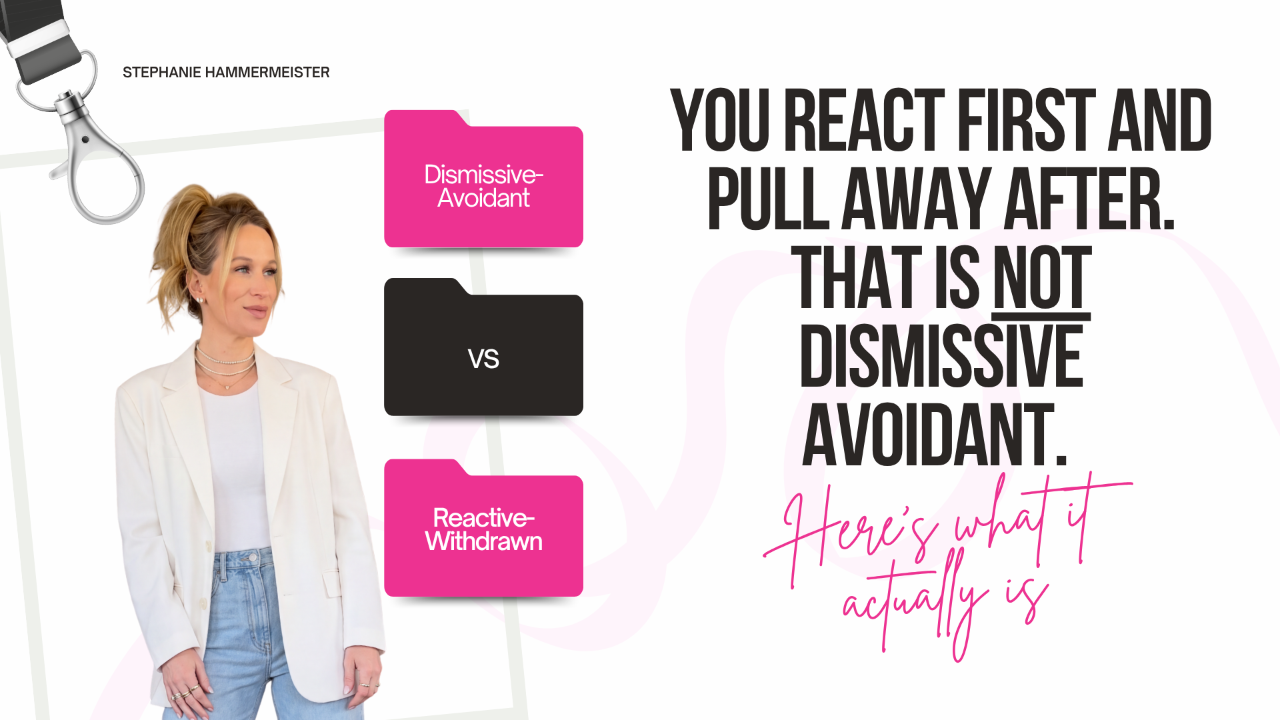
You have done the Googling. Probably at 2am, after another argument, replaying everything that came out of your mouth and trying to figure out what is actually wrong with you.
You landed on dismissive avoidant. You read the description. And something in you thought, "yes, kind of. But also not quite."
You are not imagining that gap. The dismissive-avoidant label explains part of your experience. It does not explain all of it. And the part it does not explain is actually the most important part.
Here is what is actually happening.
What dismissive avoidant actually means
Dismissive-avoidant is an attachment style. It describes a broad, consistent pattern of how someone relates to closeness, emotional need, and intimacy across most of their relationships.
The person with a dismissive-avoidant attachment style learned early that their needs were not going to be met. So the safest strategy was to stop showing them. Over time, emotional self-sufficiency became the default. They value independence highly. Closeness feels uncomfortable as a general rule. And pulling back from intimacy is not triggered by a specific moment. it is more of a baseline way of operating in relationships.
The dismissive-avoidant person does not typically react with heat before withdrawing. They tend to move toward distance quietly, without a visible emotional episode first. The avoidance is the first move, not the second.
Why it almost fits you but does not
Here is the part that probably threw you off when you were reading the description.
You are not avoidant across the board. You are not someone who struggles with closeness as a general relational posture. You are deeply invested in your relationship. You care about your partner more than you probably let on in reactive moments. You actually welcome connection. You can embrace intimate moments. You want to be the kind of partner you know you are capable of being.
What you do not want is what keeps happening instead.
The reaction fires first. The harsh words. The defensiveness. The thing you said that you cannot take back. And then, after the reaction has done its damage, you pull away. You go cold. You wait for it to blow over and for things to quietly return to normal.
That sequence goes: reaction first, withdrawal second. This is the key detail that does not fit the dismissive-avoidant description. Dismissive-avoidant people do not typically blow up before they shut down. They just shut down.
You do both. In that order. Every time.
What is actually happening
What you are describing is the reactive-withdrawn pattern. And it is more specific, more accurate, and more useful to understand than the dismissive-avoidant label because it describes the exact loop you are running, not just a general relational style.
Here is how the loop works.
Your partner says or does something that implicates an old wound. The wound that says you are the problem, you are wrong, you are the cause of someone else's emotional distress. That wound is the trigger. Your brain fires a protective response before you have had any chance to choose differently. The reaction comes out: defensive, harsh, sometimes cruel. Why? because the goal in that moment is to make your partner the problem instead of sitting inside the feeling that you are.
Then, once the reaction creates just enough internal stability that just felt like a loss of control, you withdraw. You leave. You feel like you got an upper hand. You pretend as if what just happened, never happened, and you go about your business. And you wait. Because somewhere in your history, this is how things always restored themselves. Someone got reactive. Someone withdrew. And eventually, they came back around like nothing happened and the relationship seemingly steadied (perceived safe) again.
That is the only model you ever had for how connection survive those emotional moments.
The three key differences
1. Trigger-dependent vs baseline
Dismissive-avoidant is a baseline relational orientation. The reactive-withdrawn pattern is a loop that fires when a specific trigger activates a specific wound. You can be fully present, warm, and connected with your partner until the trigger hits. The avoidance is not your default. It is your response to feeling like the problem.
2. Reaction first, withdrawal second
Dismissive-avoidant typically moves toward distance without a visible reactive episode first. The reactive-withdrawn pattern always fires a reaction before the withdrawal. The withdrawal is not the first move. It follows the explosion, the defensiveness, the sharp words. That sequence is the defining feature.
3. The wound underneath
Dismissive-avoidant is rooted in learned self-sufficiency. "I do not need anyone." The reactive-withdrawn pattern is rooted in a specific wound around being the problem. "I am wrong. I caused this. I am the reason they are upset." The withdrawal that follows is not about independence. It is about containing the shame of feeling like the problem again and waiting for the connection to restore itself the way it always did in childhood.
Where they overlap
Both patterns involve withdrawal as a strategy for managing emotional overwhelm. Both are rooted in early relational learning. Both can leave a partner feeling shut out and emotionally unsafe. And both are frequently misread as not caring, when the reality is almost always the opposite.
If you notice a reactive-withdrawn pattern happening in your life, you care deeply. You're not pulling away because you does not want the relationship. You're pulling away because staying in the emotional moment feels more dangerous than leaving it. You have no other reference point for how to handle what you're feeling with someone you care about.
Why the right label matters
Getting the label right is not about putting yourself in a box. It is about finally seeing yourself clearly enough to do something useful with what you see.
If you have been working with the dismissive-avoidant framework and feeling like it is getting you partway there but not all the way, that is probably because it is describing a different pattern than the one you are actually running.
The reactive-withdrawn pattern is specific. It has a specific trigger. A specific wound. A specific sequence. And because it is specific, it has a specific intervention point — the moment between the reaction firing and the fracture forming, where a different choice becomes available.
That intervention point is where everything can change. Not in hindsight. Not in the 2am replay. In the moment. In real time.
What to do next
If you recognized yourself in this, the next step is not more Googling. The next step is understanding what is actually happening inside the reactive moment and learning what to do with it while it is still running.
That is exactly what I walk through in my free mini-session, Stop Reacting. Start Connecting.
47 minutes. Free. The most direct walkthrough I have done of why this pattern fires, what is happening underneath it, and how to interrupt it in real time before it costs you another fracture point in your relationship.
[Watch the Free Mini-Session — Stop Reacting. Start Connecting.]
🤍